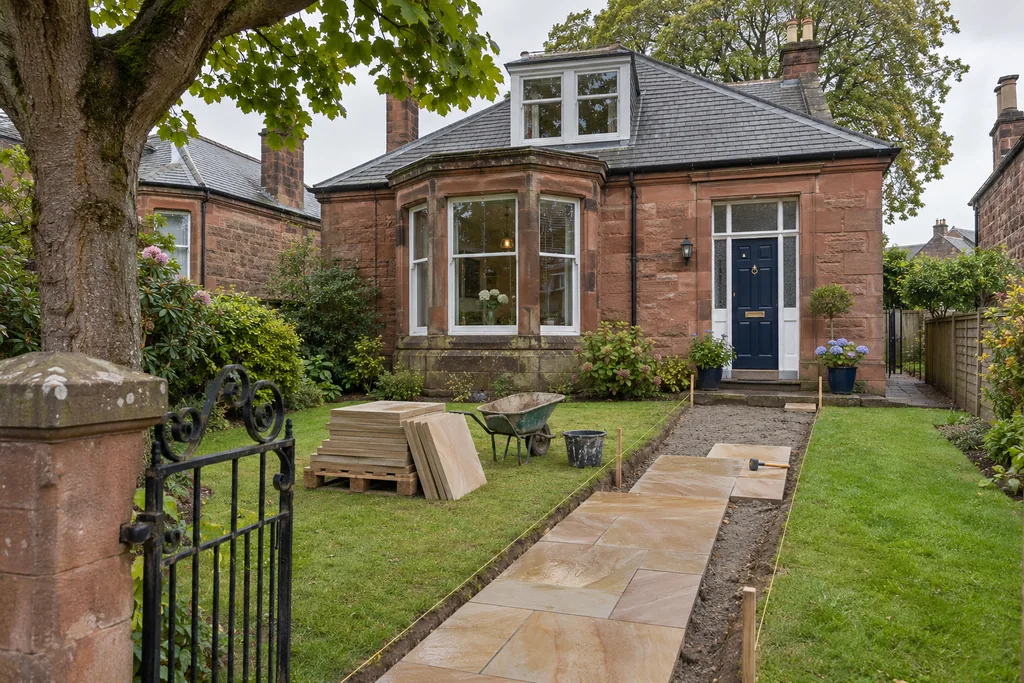
Why old stone is fussy
Put a bright new slab beside a weathered wall and your eye goes to the slab. Old sandstone has had a century or more of rain and soot, and it has settled into soft, mixed tones. A new path in a hard grey or a cold cream will stand out, even if it's good quality.
Paisley has plenty of this stone. The Abbey began as a priory in 1163 and the Thomas Coats Memorial Church has old red sandstone walls (Wikipedia, read 24 November 2026). Castlehead is a district of wooded Victorian villas (Wikipedia, read 24 November 2026), and many stone terraces sit around the centre. If your house is in that family, matching matters.
That doesn't mean everything has to be sandstone. It means the colour, the surface and the joints should agree with what's already there.
Colour first
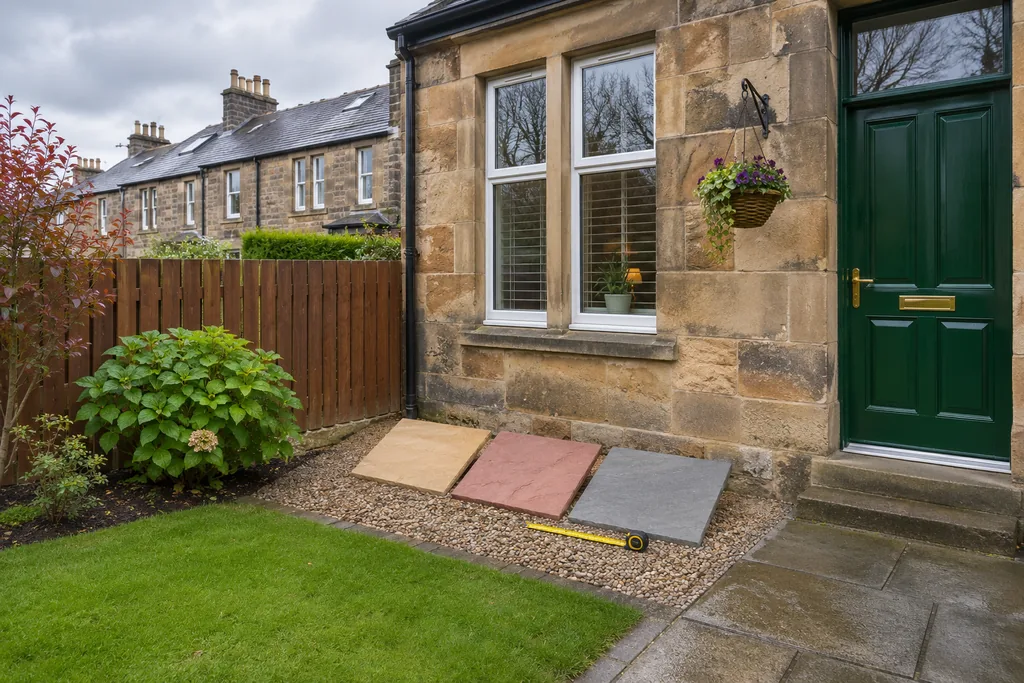
Take samples outside and lay them on the ground next to your wall. Look at them wet and dry. Look at them in the morning and the evening. A colour that matches at noon can look flat at dusk.
Red sandstone walls often look best with buff and pink-toned stone underfoot, because the warmth carries across. Grey sandstone walls can take a cooler grey or a pale buff. A darker slab can make a narrow front garden feel tighter, so think about the size of the space as well as the walls.
Porcelain is a fair option when you want an even, tidy look. A soft sand or warm grey will sit quietly beside old stone, though it won't blend the way natural stone does. We'd tell you plainly which we'd pick for your wall.
Face, size and joints
Surface texture is part of the match. A rough, riven face looks natural beside old walls. A very smooth, sawn face reads as modern. Neither is wrong, but the combination matters.
Size and pattern also count. Victorian paths were often laid in simple, regular courses. A random mix of sizes can look right in a garden and wrong in a formal front path. Keep the pattern calm.
Joints are the detail people forget. Wide, pale joints draw attention to every slab. A narrow joint in a tone close to the stone looks tidier. Ask what jointing material is planned and what it will look like when it's dry.
- Pick a texture that echoes the wall
- Keep the pattern simple on a front path
- Choose a joint colour close to the stone
Footings, damp courses and roots
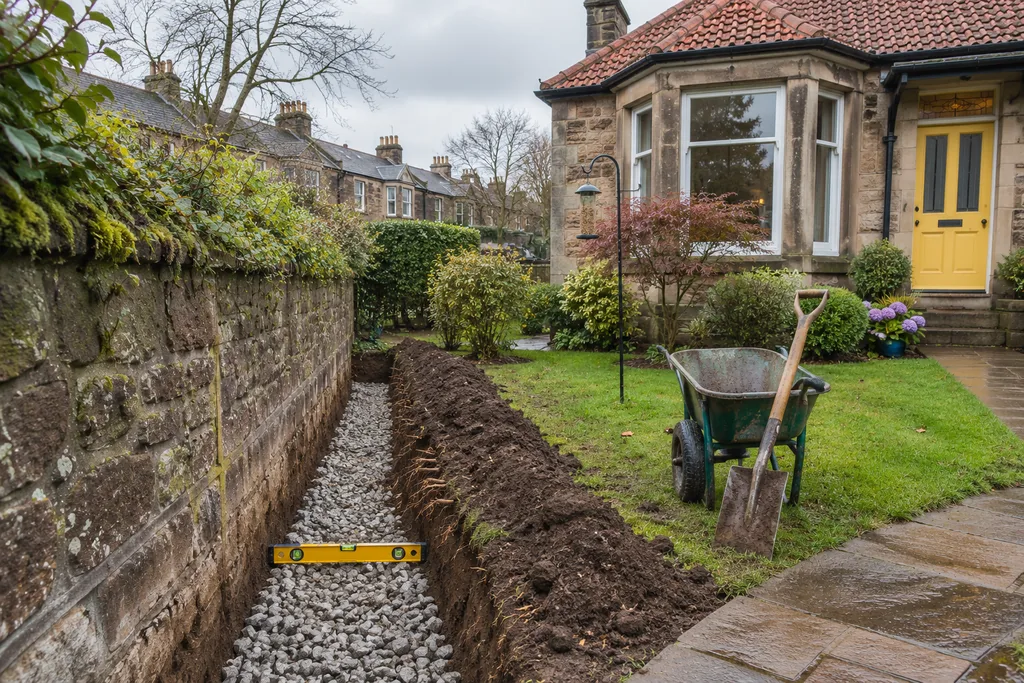
Old walls don't stand on deep concrete. Many sit on shallow stone footings, and a heavy dig close to one can disturb it. We keep the base back from the wall, and where we have to work near it, we dig by hand and stop if the ground looks unstable.
Damp is the other point. The finished paving should sit well below the damp-proof course, or below the point where the wall's stone begins if there isn't one, with a fall that carries rain away. If your wall has damp rising already, new paving that sheds water against it will make that worse, and a drained gap or channel at the foot might be better.
Trees need a mention. In wooded streets like Castlehead, roots run under lawns. Cutting a large root can harm a tree, and cutting roots on a protected tree can mean needing the council first. If the dig will go near a big trunk, tell us before we start.
The council, the map and the rules
Renfrewshire has eight conservation areas: Castlehead, Greenlaw, Houston, Kilbarchan, Lochwinnoch, Ranfurly in Bridge of Weir, Paisley Town Centre and Thornly Park (news report on the council's conservation guide, the-gazette.co.uk, undated, read 24 November 2026). The report says new work in these areas has to preserve and enhance their character and appearance. Wikipedia also names Oakshaw, the old centre beside the Abbey, as a conservation area (read 24 November 2026).
On mygov.scot (last updated 18 November 2025), the Scottish Government says the general allowance for hard surfaces doesn't stretch to houses in conservation areas or near listed buildings. A surface that faces the road also has to let water through, or send it onto a lawn or border.
A dropped kerb is work in a public road and needs the roads authority's written consent first (Roads (Scotland) Act 1984, section 56; legislation.gov.uk, up to date to 22 November 2026). In Paisley, that's Renfrewshire Council.
None of that is a reason not to pave. It's a reason to ask before you order slabs.
Keeping it looking right
Natural sandstone changes with weather. Shaded patches grow moss, and some stone darkens in the wet. A stiff brush now and then stops moss building up, and a yearly wash is plenty for most gardens. Sealers can reduce staining but can also change the look of the stone, so ask the supplier first and test a small spot.
Cut back hedges that drip on the path. It's the shade and the drip that cause most of the green. If a bit of moss doesn't bother you, it adds to the old look.
Questions to ask a paver
- Can I see samples beside my own wall?
- How will you protect the old footings and any tree roots?
- What goes under the slabs, and how deep is it?
- Where will the rain go?
- Who checks the conservation-area and kerb rules?
- What colour will the joints be?
A short, specific answer is a good sign. If you'd like to talk through your own wall, see sandstone paving in Paisley, or ring.
Questions
Does paving have to be sandstone to suit a stone house?
No, but it should agree with it in colour and tone. A soft porcelain can work, and sandstone is the closest match.
Can new paving cause damp in an old wall?
It can if it sits too high or sheds water towards the wall. The surface should be below the damp-proof course with a fall away.
Can I lay paving in a conservation area?
Often, but the usual allowance doesn't apply there. Ask Renfrewshire Council before you start.
Will moss spoil the look?
Some people like it. A brush and a cut-back hedge keep it down if you don't.
Is a stone path slippery?
It can be when wet and green. A textured face and regular brushing help.