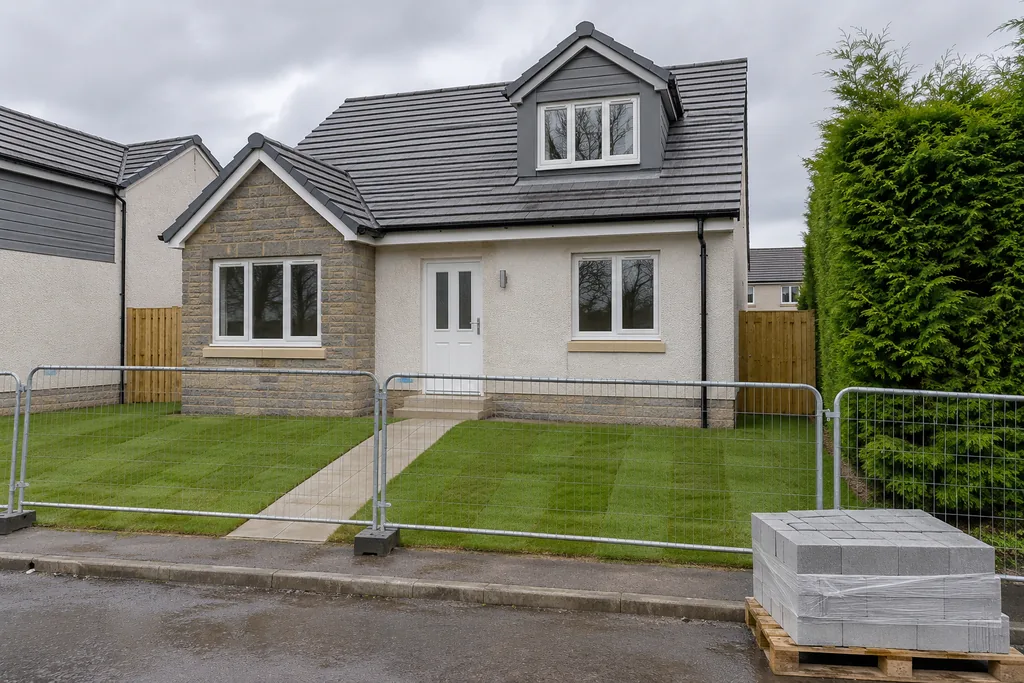
The plot you're handed
New homes tend to come with the bare minimum at the front. A rectangle of turf, a pavement and a pair of bin spots. Plenty of owners want somewhere for two cars, a clear path to the door and maybe a bit of border.
Renfrewshire has plenty of newer housing alongside the older streets, so this is a common job. The good news is that a new-build front plot is simple to measure and flat to work on. The detail is below the turf.
Before you phone anyone, do three small things. Stand at the front and decide how many cars need to park, and whether anyone has to open a car door onto the path. Look at the pavement edge to see whether a dropped kerb is already there. Then check how rain behaves on the plot after a heavy shower, because puddles at the boundary tell you where the water wants to go. Those three answers shape the quote more than the colour of the blocks.
What's under the turf
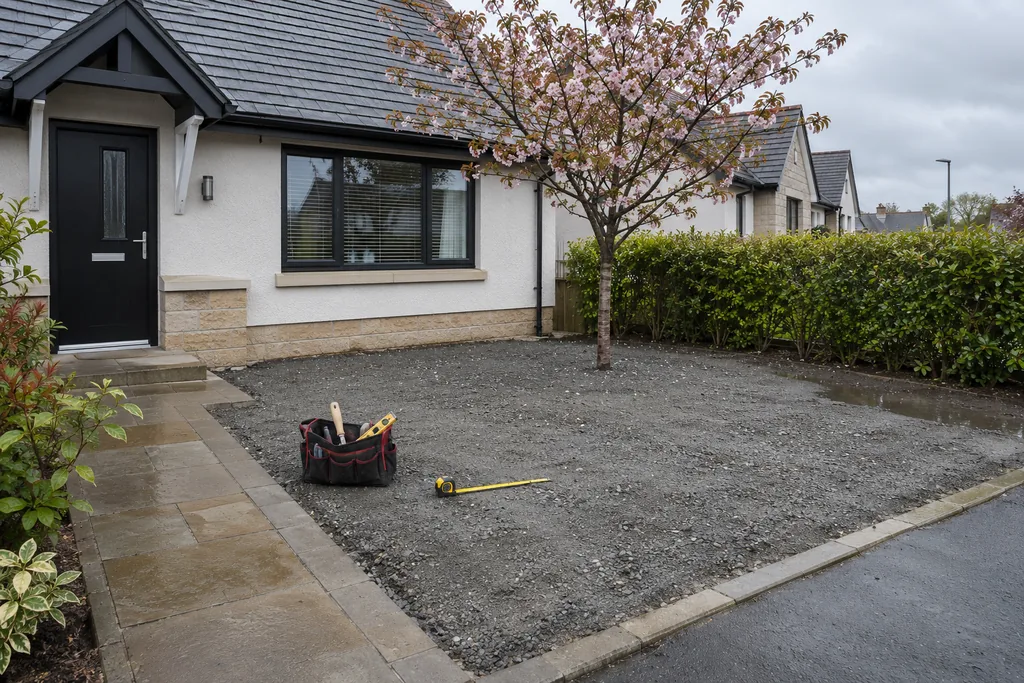
The ground around new houses is often fill, brought in and packed down during construction. It can be firm, but it can also hold water, and it sometimes contains bricks, offcuts and bits of old services. Heavy use after a wet spring can show weak spots.
That's why we look before we quote. We dig a small test, see how it behaves and plan the depth. Where the fill is poor, we remove it and build a proper base. On good ground, we can dig less.
A drive for a small hatchback and a drive for a van are different. Tell us what will park and we'll build to it.
The base
A block-paved parking space is built in layers.
- Dig. Turf and soft ground come out to firm ground.
- Stone. Crushed stone is spread and compacted in thin layers, thicker for vehicles than for a path.
- Bed. A thin, level layer of grit takes the blocks.
- Lay. Blocks are laid to a pattern, cut at the edges and plated down.
- Joints. Sand is swept in and the plate goes over again.
Each stage matters. A thin base under a car sinks in the wheel paths, and uneven bedding shows as ripples in the surface.
Pattern, colour and edge
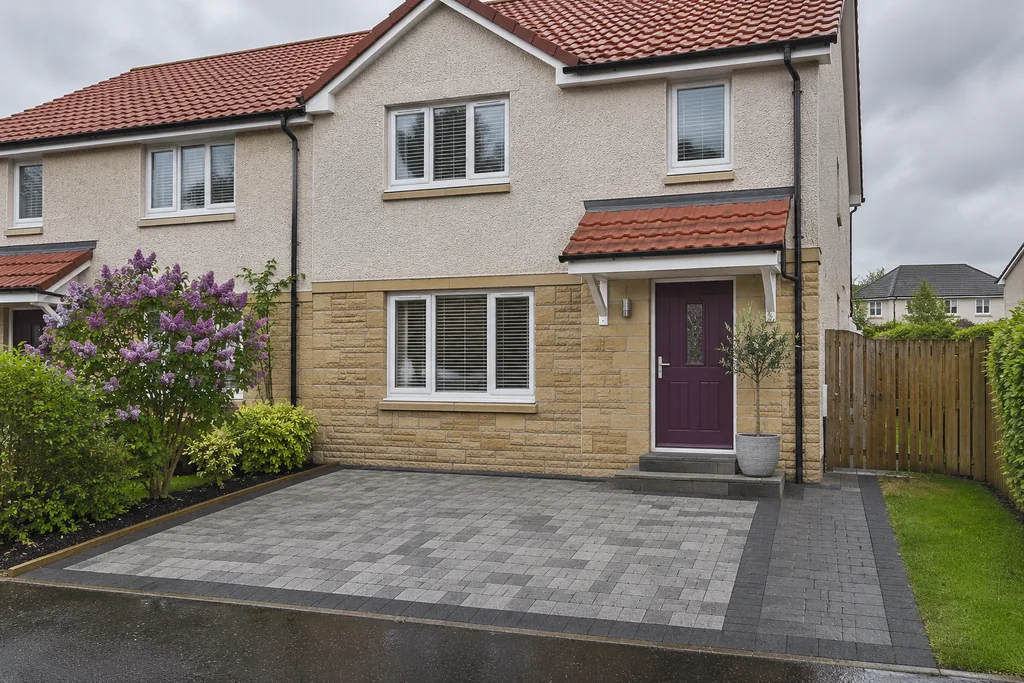
Herringbone is the usual pattern for a parking space because it spreads the load and resists the push of turning tyres. A plain stretcher bond is neater for a path. Two greys with a darker border give a finished look without being fussy.
Edge restraints hold everything in. On a new-build plot with a kerb on one side and a lawn on the other, the lawn side needs a firm edge. Without one, the blocks drift outward over a couple of winters.
For more on the options, see block paving in Paisley and paving styles.
The kerb
If your parking space opens onto the road over the pavement, the kerb comes into it. A new house may or may not already have a dropped kerb. Where it doesn't, a dropped kerb is work in a public road, and the Roads (Scotland) Act 1984, section 56, says no works may be done in a public road without the roads authority's written consent (legislation.gov.uk, up to date to 22 November 2026). That's Renfrewshire Council for Paisley, Renfrew and Johnstone.
Ask before you pay for blocks. A parking space that can't be reached over the pavement is a very expensive lawn.
Rain and the council
A front surface facing the road has to deal with its own rain. The Scottish Government says on mygov.scot (last updated 18 November 2025) that this means porous material, or a fall onto a lawn or border. The same page puts conservation-area houses and homes near listed buildings outside the general allowance. New housing is unlikely to be listed, but some of it sits at the edge of older areas.
On a tight new-build plot, the best way to meet the rain rule is a fall toward a border, or permeable blocks with the right sub-base. We'll explain which one suits your plot.
Check with Renfrewshire Council on planning, and on anything unusual about your estate. Some developments also have title conditions about parking and surfaces, so look at your deeds.
Questions to ask a paver
- What's under my turf, and what will you do about it?
- How thick is the base for my vehicle?
- How is the edge held on the lawn side?
- Where will the water go?
- Who deals with the dropped kerb?
- What happens to the spoil?
Questions
Can I have a block-paved space right up to my front door?
Often, but the rain rule still applies and you need space for the door to open. We'll sketch it.
Do new-build deeds stop me paving?
Some do. Read your title conditions and check with the developer if you aren't sure.
Can blocks go straight on the new turf?
No. The turf and topsoil come out first, and a proper base goes in.
Will it need sealing?
Some blocks do. Ask us and ask the supplier.
What is the next step?
Ring or use the form.